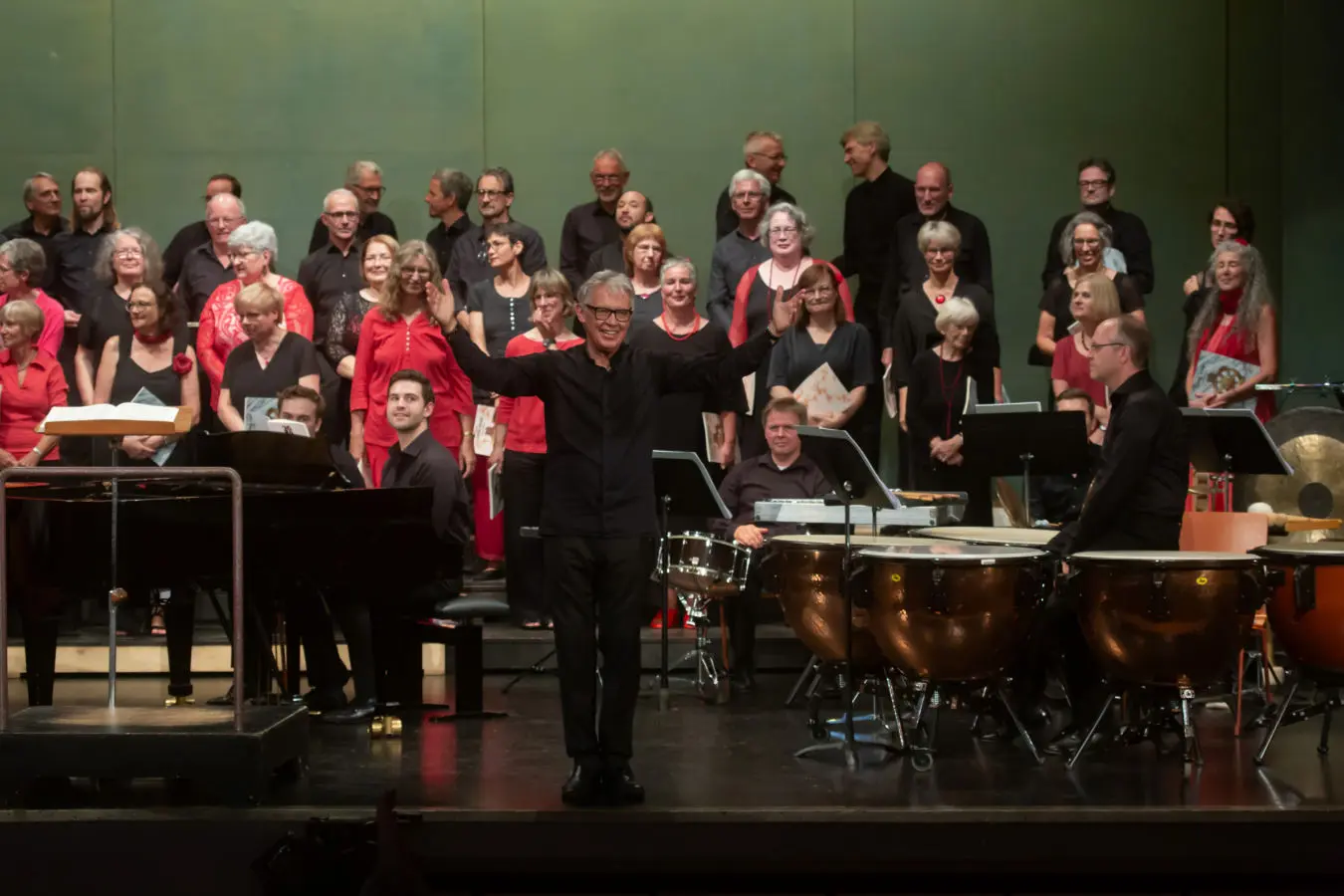
A conductor stands on stage with raised arms in front of a choir and orchestra, with choir members dressed in red and black.

Un’esperienza concertistica straordinaria (2)

Posted on

In taberna La seconda parte, In taberna, è ambientata in una taverna medievale dove si incontrano solo uomini. Qui impariamo a conoscere la “vita di strada”, la “golosità” e i “banchetti”, il “gioco d’azzardo” e le sue spiacevoli conseguenze e infine l’eccessivo “bere” ai tavoli. Con la confessione del vagabondo Estuans interius , Orff inizia con uno strappo verdiano. Qui il baritono Kai Preußker ha brillato per drammaticità operistica, potenza vocale e un’enorme estensione vocale. Preußker si è dimostrato sicuro di sé e accattivante sotto tutti gli aspetti, suscitando a sua volta applausi entusiastici. Al sospirato intro di pianoforte, il Lesen Sie mehr …

A choir performs on stage with a conductor leading in front. Singers are grouped in rows, wearing black and red clothing. Musicians sit at a piano and orchestral percussion instruments are visible.

“Carmina Burana” auf der Uhlandshöhe

Posted on

Für den Chor hat Carl Orff in seinem legendären Werk bekanntlich eine ganze Reihe von „stimmlich-musikalischen Hürden“ eingebaut, die es zu überspringen gilt. Lang ausgehaltene, „höchste“ Lagen in den Sopranen und Tenören, knifflige rhythmische Komplikationen, viele Stimmteilungen (bis zur Achtstimmigkeit), anspruchsvolle Männerchöre, schnelle Tempi, viele Tempowechsel, jede Menge Text für den Chor und so einiges mehr. Aber auch die Solisten-Partien sind „am Rande des Möglichen“. Die Bariton-Arien fordern vom Solisten einen Stimmumfang über jeder Bariton-Bandbreite und eine Ausdrucksweite, die das Äußerste abverlangt. Für die Sopran-Nummern gilt das Gleiche. Es bräuchte eigentlich drei Sängerinnen mit verschiedenen Sopran-Profilen. Und der Tenor singt Lesen Sie mehr …

A choir performs on stage under the direction of a conductor, with members holding sheet music. Musicians accompany them, including a pianist and percussionist. The scene is brightly lit, creating a formal concert atmosphere.

“Carmina Burana” at the Uhlandshöhe

Posted on

For the choir, Carl Orff is known to have built into his legendary work a whole series of “vocal-musical hurdles” that have to be jumped. Long sustained, “highest” registers in the sopranos and tenors, tricky rhythmic complications, many voice divisions (up to eight-part harmony), demanding male choruses, fast tempi, many tempo changes, lots of text for the choir and so much more. But the soloist parts are also “on the edge of the possible”. The baritone arias demand from the soloist a vocal range above any baritone bandwidth and a breadth of expression that demands the utmost. The same applies Lesen Sie mehr …